Your new window treatments are here—time to bring your space to life! Follow our clear, step-by-step installation instructions to ensure a smooth setup and a flawless finish.
Let's get started!

Digital Instructions Available
Your new window treatment come with detailed manufacturing instructions. If you happen to misplace the instructions, a digital copy is always available on the product page.

Always Here to Help
If you have any questions or need a bit of guidance along the way, our expert design consultants are here to help. Give us a call at 800-505-1905.
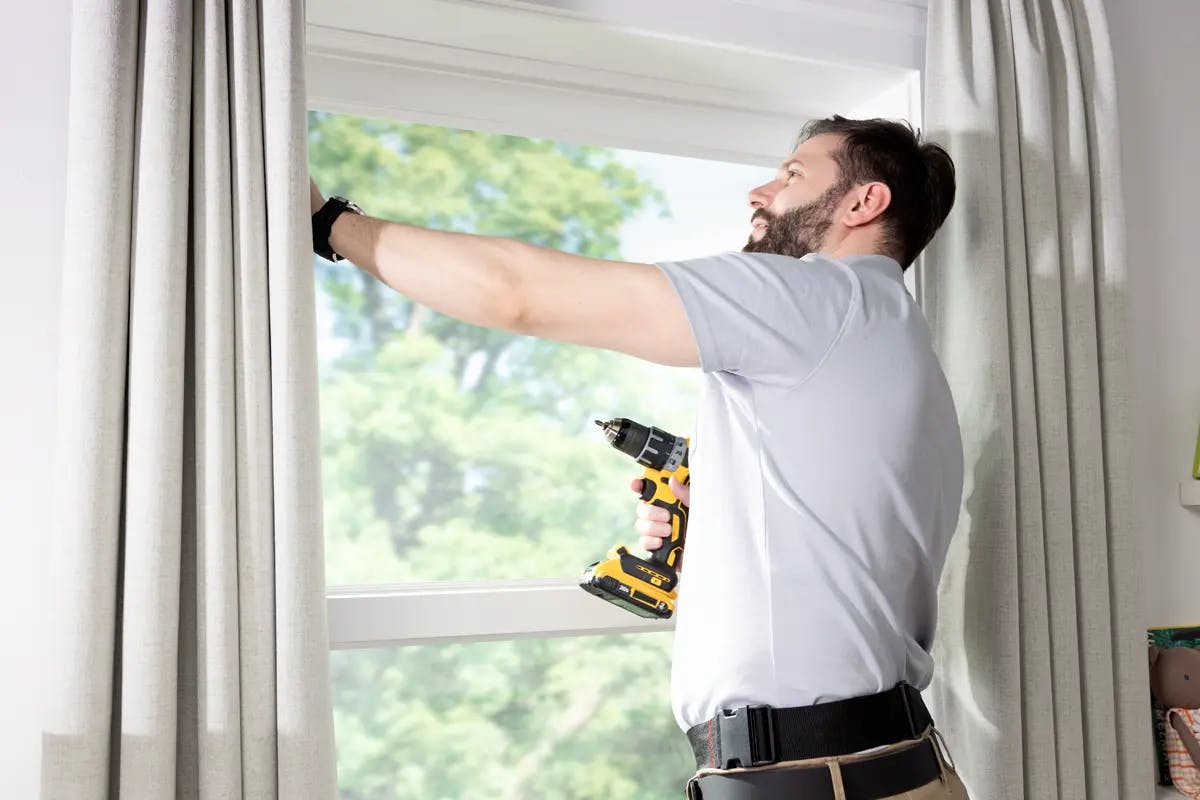
Let the Pros Handle It
Prefer to have a licensed professional handle the installation? No problem! Check the availability of our vetted experts in your area here.
Blinds & Shades Installation Tips
A little prep goes a long way. Here are a few things to check before you install your new window treatments.

Clear the Area & Check for Obstructions
Move any furniture or items out of the way to give yourself plenty of space to work. Also, check for anything around the window, like sills, trim or other objects, that might get in the way.
Check Your Hardware
Open the packaging and confirm you’ve got all the parts: screws, brackets and mounts. It’s much easier to sort out missing pieces now rather than halfway through the install.
Keep and Follow Manufacturer’s Instructions
Make sure to keep your manufacturer’s instructions handy. While this guide provides a general overview, small details may vary by style. Always refer to the instructions for specifics that can make installation easier.
Consider Wall Material & Anchors
Pay attention to what kind of wall you're drilling into (drywall, brick, plaster, etc.). For drywall, you’ll need drywall anchors, and for brick or plaster, you might need specific anchors and screws. Have the right materials ready to go.
Know Your Mount Type
Your blinds or shades are either an inside mount or an outside mount, and you need to install them according to the type you measured for:Inside Mount sits inside the window recess for a clean, built-in look.Outside Mount is installed above the window to cover the full frame.
How to Install Blinds and Shades
Installing Traditional Blinds & Shades
Now that you’re ready, here’s how to install your new window treatments step by step:
General Instructions
-
- Inside Mount: Hold the bracket in the upper corner inside the window frame where the headrail will sit. Make sure it’s flush with the wall or frame surface.
- Outside Mount: Hold the first bracket in the upper corner above the window frame, ensuring it’s flush with the wall
Tip: If your window treatment has a decorative valance, position the brackets slightly deeper into the frame (inside mount) or farther from the wall (outside mount) to give extra clearance. For a more secure fit with inside mounts, we suggest drilling at an angle.
-
Use a pencil to mark the screw hole positions for both brackets.
-
- Inside Mount: Move to the opposite upper corner inside the window frame and repeat steps 1 and 2. Ensure both brackets are at the same height.
- Outside Mount: Move to the opposite upper corner above the window frame and repeat steps 1 and 2. Ensure both brackets are at the same height.
-
Use a level to ensure the brackets marks are evenly aligned. Getting this right will make sure everything fits neatly.
Tip: If you don’t have a level, you can measure the distance from the top of the window frame to each bracket mark to make sure they’re the same height.
-
Using a drill bit slightly smaller than the screws, drill pilot holes where you’ve marked the screw positions. This helps the screws go in smoothly.
Tip: If you hit a stud when drilling into drywall, use longer screws to keep the brackets in place.
-
Align the brackets with the pilot holes and screw them into place. Tighten the screws enough to hold the brackets securely, but don’t over-tighten to avoid damaging the wall or the brackets.
Tip: If you’re mounting into drywall without studs behind, make sure to use drywall anchors for extra support.
-
Slide the headrail into the brackets and make sure it’s firmly in place. Some headrails snap into place, while others may need you to secure them with bracket covers.
-
Test your blinds or shades by raising and lowering them and rotating the slats (if applicable). Make sure everything operates smoothly.
Tip: If the window treatment isn’t moving smoothly, check the bracket placement again and make sure everything is secure.
Special Considerations for Specific Window Treatments
-
- Outside Mount: Position the brackets about 2 ½ inches from the top of the window frame.
- Testing: Raise and lower the shade to make sure it operates smoothly. If the shade binds or sticks, adjust the stopping feature.
-
- Inside Mount: Position the brackets about 1” in from the top corners of the window frame.
- Outside Mount: Position the brackets 2” to 3” above the window frame or trim.
- Testing: Roll the shade up and down to make sure it rolls evenly. If it's too tight or loose, adjust the tension system.
-
- Outside Mount: Position the brackets at least 2 ½” from the top of the window frame.
- Testing: Raise and lower the shade to make sure it operates smoothly. Double-check that it stays in place when fully extended.
-
- Bracket Installation Inside Mount: Align the valance facing the room, and position bracket clips 3 inches in from each side of the window. Outside Mount: Measure from the bottom of the window to where the blinds will hang. Mark the top of the window, then center the headrail above this point and mark 3 inches in from each end.
- Attach the Vanes: Pull the cord to space the vanes evenly. Slide each vane into the plastic stem at the top of the headrail until it clicks into place. Repeat for each vane.
- Install the Safety Bracket: Attach the safety bracket near the bottom of the window frame (for inside or outside mounts) to keep the cord or chain taut.
- Testing: Use the pull cord to open and close the blinds, and use the tilt chain or wand to adjust the vanes. Everything should move smoothly!
Installing Curtains & Draperies
-
- Start by aligning a steel measuring tape vertically in the center of your window.
- Lower the tape to the point where you want the bottom of your drapery fabric to rest.
- Extend the tape upward to the full length of your panel and mark lightly with a pencil.
- From this mark, measure out half the rod length on each side.
- Subtract 6 inches for the brackets and mark the top of your tape.
-
Wood Brackets
- Loosen the screws on the back of the bracket holders.
- Remove the holders and align the bottom of the center opening over your pencil mark.
- Make two guide marks through the top and bottom openings.
- Reattach the bracket holders to both sides of the window.
- Slide the screws into the slots and secure the hardware to the wall.
Metal Brackets
- Align the top of the bracket over your pencil mark and make two guide marks.
- The bracket comes in two pieces: an L-shaped mount and a holder for the drapery rod. Secure the short end of the L-bracket to the wall with screws.
- Place the rod holder into the groove on the bracket and adjust to position the rod where you want it.
- Tighten with the adjustment screw.
-
If necessary, use plastic wall anchors to secure your mounting hardware. Refer to your product instructions for guidance.
-
Follow your product instructions to assemble the drapery rod. You may need to remove a finial, slide the curtains onto the rod, or add rings equal to the number of hooks on your drapery. Once the drapery is in place, replace the finials.
-
Carefully place the rod onto the brackets and arrange the curtains/draperies in the desired position.
Installing Interior Shutters
-
Set up your work area, laying out the frames and strips on a soft surface like a carpet or quilt. Match the corners to ensure everything fits properly.
-
Tap the key into the pre-routed slots on the back of each frame to assemble it.
-
- Inside Mount: Place the frame inside the window opening, making sure it's centered and level.
- Outside Mount: Position the frame outside the window, centered and level as well.
-
Screw the frame into the wall in three spots: top left, top right and top center. This will ensure the frame is square and level.
-
Insert the hinge pins to attach the panels to the frame. Open and close the panels to check for gaps and alignment. Adjust the side frames if needed to eliminate any gaps.
-
Once aligned properly, secure the frame using additional screws through the pre-drilled holes.
-
Place the catch on the lip of the window frame, ½” from the inner edge of the stile. Screw it into place.
-
Close the panel and position the strike plate over the catch. Mark where the button should go on the panel (1/2” from the inner edge). Then screw the button into the panel.
Installing Additional Features
-
- Identify where to place the support brackets based on the width of your window treatment.
- For blinds or shades wider than 60”, you’ll want to install a support bracket in the center, with at least one more along the length for extra stability. Tip: For wood, faux wood and mini blinds, install the bracket slightly off-center to avoid interfering with the cord.
- Use a level to double-check that everything is aligned before securing the brackets.
- Mount the support bracket into the wall with screws, anchoring them into studs or using wall anchors for extra hold.
- After everything’s attached, test the window treatment to make sure it doesn’t sag when fully extended.
-
- Once your blinds or shades are mounted, position the valance clips or brackets along the top edge of the headrail.
- Snap the valance into place, spacing the clips evenly for a neat, balanced look.
- Double-check that the valance is secure and doesn’t block the blinds or shades from moving.
SureFit™ Guaranteed
Mistakes Happen. We've Got You Covered!
With SureFit™, a Blinds.com exclusive, we make sure you have complete peace of mind when measuring for most products we offer.
If you made a mistake measuring your blind, we'll remake it at no cost to you.*
